Postres
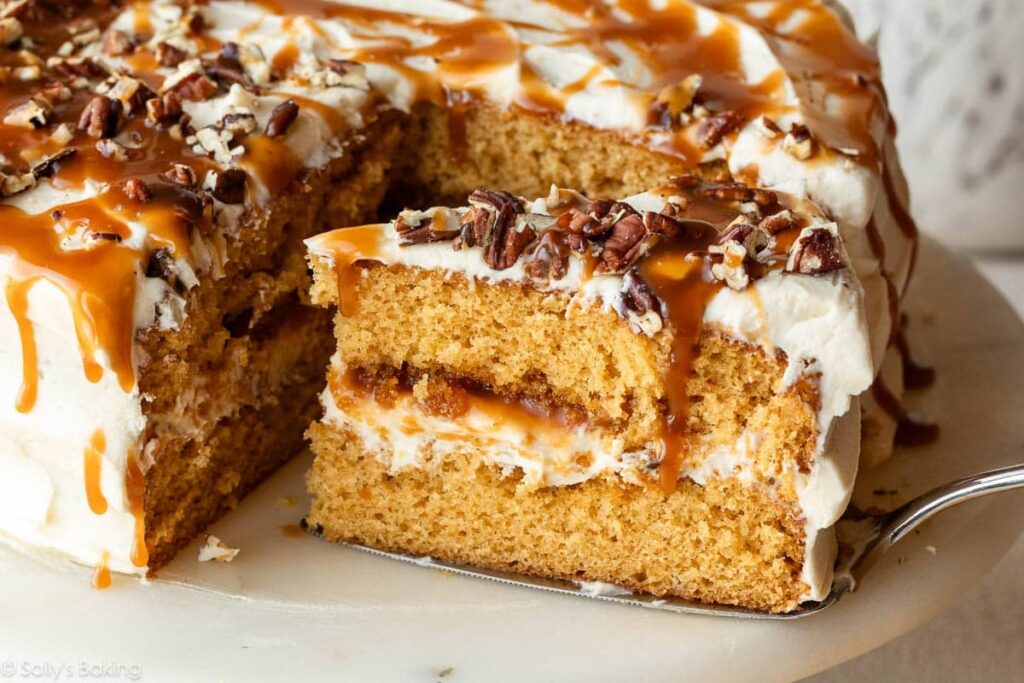
Pastel de azúcar quemada con caramelo profundo
🧺 Ingredientes
Las cantidades se recalculan solas. La receta está escrita para 10.
- 1 cup (200g) granulated sugar
- 3/4 cup (180g/ml) boiling water
- 2 and 1/2 cups (285g) cake flour (spooned & leveled)
- 2 teaspoons baking powder
- 1/2 teaspoon baking soda
- 1 teaspoon salt
- 3/4 cup (12 Tbsp; 170g) unsalted butter, softened to room temperature
- 1 cup (200g) granulated sugar
- 4 large egg whites, at room temperature
- 1/2 cup (120g) sour cream, at room temperature
- 2 teaspoons pure vanilla extract
- 1/2 cup (120g/ml) whole milk, at room temperature
- 1/2 cup (120ml) cooled burnt sugar syrup
- 1 cup (16 Tbsp; 226g) unsalted butter, softened to room temperature
- 4 cups (480g) confectioners’ sugar
- 1/4 cup (60g/ml) cooled burnt sugar syrup
- 1 teaspoon pure vanilla extract
- 2 Tablespoons (30g/ml) whole milk or heavy cream
- 1/4 teaspoon salt
- homemade salted caramel, cooled
- optional: 1/2 cup (60g) chopped toasted pecans*
👩🍳 Paso a paso
-
For best success, read the recipe in full before starting.
-
first so it has time to cool. Make sure you have boiling water at the ready. Place the sugar in a medium saucepan over medium heat. I recommend using a 3-quart heavy-bottomed quality saucepan. Stirring constantly with a wooden spoon, cook until the sugar has completely melted and is deep amber in color, about 8–10 minutes. If the sugar is clumpy, try to break up the lumps with the wooden spoon. A candy thermometer is not necessary, but if you’re using one, the sugar temperature should reach about 300°F (149°C) when it’s ready. Reduce the heat to low and very carefully and slowly drizzle in the boiling water, a little at a time. Stir after each addition and stand back, as the mixture will rapidly sizzle and bubble. After all of the boiling water is stirred in, cook the sugar syrup for 3 more minutes over low heat, stirring the entire time. Remove from heat and let it cool completely. You will have about 1 cup of syrup.
-
Preheat the oven to 350°F (177°C). Grease two 9-inch round cake pans, line with parchment paper rounds, then grease the parchment paper. Parchment paper helps the cakes seamlessly release from the pans. (If it’s helpful, see this parchment paper rounds for cakes video & post.)
-
In a medium bowl, whisk together the cake flour, baking powder, baking soda, and salt. Set aside.
-
In a large bowl using a handheld or stand mixer fitted with a paddle attachment, beat the butter and sugar together on medium-high speed until light and creamy, about 3 minutes. Scrape down the sides of the bowl with a silicone spatula as needed. (Here’s a helpful tutorial if you need guidance on how to cream butter and sugar.) Add the egg whites and beat on medium-high speed until combined, about 2 minutes. Scrape down the sides and bottom of the bowl as needed. Add the sour cream and vanilla extract, and beat on medium-high speed until combined, about 1 minute. Add the dry ingredients and then, with the mixer running on low speed, slowly pour in the milk, followed by 1/2 cup (120ml) of the cooled burnt sugar syrup, and beat just until combined. Do not overmix. You may need to whisk it all by hand to make sure there are no lumps at the bottom of the bowl. The batter will be slightly thick. Divide the batter evenly between the prepared pans.
-
Bake for 22–25 minutes or until the cakes are baked through. As a result of the burnt sugar syrup in the batter, the cakes will be a deep golden brown. To test for doneness, insert a toothpick into the center of the cake. If it comes out clean, it’s done. Allow cakes to cool completely in the pans set on a cooling rack.
-
As the cakes cool, I suggest making the salted caramel. Let the salted caramel cool until it is no longer warm and has a thick, drizzleable consistency before using. If refrigerated caramel is too thick to drizzle, warm it in 5–10-second intervals, stirring between each, just until pourable. You can also toast the pecans during this time. See recipe Notes.
-
In a large bowl using a handheld mixer or stand mixer fitted with a paddle attachment, beat the butter on medium speed until creamy, about 1–2 minutes. Add confectioners’ sugar, 1/4 cup (60ml) of the cooled burnt sugar syrup, vanilla, milk/cream, and 1/4 teaspoon of salt. Beat on low speed for 30 seconds, then increase to high speed and beat until completely combined, about 2 minutes. Add more confectioners’ sugar if frosting is too thin or more milk/cream if frosting is too thick. Taste. Add more salt if desired. (Note: You will have some burnt sugar syrup left over. If desired, lightly brush a little onto the leveled cake layers before assembling.)
-
(For additional help with this step, see this how to assemble a layer cake video & post.) First, using a large serrated knife or cake leveler, slice a thin layer off the tops of the cakes to create a flat surface. Discard (or crumble over ice cream!). Place one cake layer on your cake stand, cake turntable, or serving plate. Using a large icing spatula, spread 3/4–1 cup (180–240g) of the frosting in an even layer on top. Drizzle 1/4 cup (about 75g) of salted caramel on top of the frosting. Top with the second cake layer. Refrigerate the cake for at least 30–45 minutes to allow the caramel inside to set. After it has chilled, spread the remaining frosting all over the top and sides. Run a bench scraper around the cake to smooth out the sides, if desired. Garnish with another drizzle of salted caramel and toasted pecans, if using. Slice and serve.
-
Cover leftover cake tightly and store in the refrigerator for up to 5 days. I like to use a cake carrier for storing and transporting.
Este pastel lleva un jarabe casero de azúcar quemada que le da un sabor a caramelo intenso y único.
Por qué importa
- Aprenderás a hacer jarabe de azúcar quemada, una técnica que transforma el sabor de cualquier postre.
- Lograrás un pastel con caramelo auténtico sin usar productos comerciales ni atajos artificiales.
Contexto
El secreto está en caramelizar azúcar seca en una olla hasta que se derrita completamente y tome color oscuro, luego agregar agua hirviendo con cuidado para crear el jarabe. Este jarabe se incorpora a la masa del pastel. Ingredientes: azúcar granulada (para el jarabe y la masa), agua hirviendo, mantequilla, huevos, harina de trigo, polvo de hornear, sal, leche, vainilla. Pasos: 1) Cocina azúcar en olla hasta caramelizar, añade agua hirviendo despacio, deja enfriar. 2) Bate mantequilla con azúcar, agrega huevos. 3) Mezcla harina, polvo de hornear, sal. 4) Alterna ingredientes secos con leche y jarabe quemado. 5) Hornea hasta que al insertar palillo salga limpio. 6) Decora con glaseado de caramelo o crema.
Lo que sigue
Prueba esta técnica en otros postres como galletas o flanes.
Tazas → gramos
Equivalencias de cocina, redondeadas. Para repostería fina, pesá.
El vino sin complicarte
Espumoso dulce, bien frío
Con un postre, el vino tiene que ser al menos tan dulce como el plato. Si es más seco, al lado del azúcar sale agrio y parece un vino malo sin serlo. Servilo a 6 grados.
Sin alcohol: un café negro sin azúcar también funciona, porque hace el trabajo contrario y corta el dulce en vez de seguirlo.
Recomendación editorial, sin marcas ni puntuaciones. Consumo responsable. Prohibida la venta de alcohol a menores de edad.
Basada en Sally's Baking Addiction, con receta y texto propios.